
Business & Civil Legal Services | U.S. Legal Explainer
Learn when employment counsel may help workers or employers and what documentation matters in a workplace dispute.
Choosing legal representation for employment law is easier when the issue is divided into decisions instead of marketing claims. The attorney’s work depends on the facts, jurisdiction, available documents, the other people or organizations involved, and the outcome the person actually needs. This guide explains the moving parts without claiming that one legal strategy fits every case in the United States.
The topics below move from the first signs of a legal problem to evidence, procedural choices, and the practical questions to ask before signing an engagement. They are written for readers who want to understand a professional service, not for people seeking a substitute for advice based on a confidential review of their particular circumstances. State law, venue, contract wording, and filing dates can all alter the analysis.
For business & civil legal services, an effective first conversation often produces a narrower, more useful question than “Can I win?” It should clarify which facts are established, which claims or obligations are still disputed, what records matter, what action cannot wait, and who is responsible for the next step. Use the five-part decision map as a navigation aid rather than a scorecard predicting results.
Clarify the type of workplace issue
An unfair experience and an unlawful employment practice are not identical concepts. An attorney distinguishes discrimination, harassment, retaliation, wage-and-hour concerns, leave disputes, contract claims, and workplace safety issues. Each may involve different laws, institutions, remedies, coverage thresholds, and procedural steps.
Ask the prospective lawyer to demonstrate how clarify the type of workplace issue fits into the specific employment law decision, what they would examine first, and what finding would prompt a change of course. Their answer should acknowledge that a short initial meeting cannot substitute for reviewing the actual evidence.
Protected grounds and conduct
Federal discrimination rules address specified characteristics and retaliation for certain protected activities, while state and local laws may provide additional protections. A lawyer analyzes what conduct occurred, who knew of it, what adverse action followed, and whether relevant comparators or contemporaneous records exist. No isolated unpleasant comment proves every element of a claim.
For this stage, keep the protected conduct question distinct from the broader dispute. Ask whether the service being offered covers investigation, document preparation, negotiation, and appearances, or only selected tasks. A written scope prevents misunderstandings when the work expands.
Deadlines come unusually early
EEOC charges generally face time limits that can depend on jurisdiction and the type of allegation. The commonly described 180-day period can extend to 300 days in qualifying circumstances, but exceptions apply; federal employees follow a different process. A claimant should seek local guidance immediately rather than rely on a generic online calculator.
Before acting on advice about deadlines come unusually early, ask what is a binding requirement and what is merely a recommended practice. Counsel should distinguish the two, note whose authorization is needed, and flag any step that might permanently narrow the available options.
Wage and classification questions
Time records, schedules, job duties, pay statements, deduction policies, and messages can matter when reviewing overtime, minimum wage, or classification issues. Titles such as manager or independent contractor are not conclusive by themselves. An employment lawyer looks at the governing legal tests and the work actually performed.
In a case involving employment law, the timing of this decision can be as important as its substance. Request the next material deadline, the form of notice or filing that applies, and a sensible contingency if a record or third-party response arrives later than expected.
Internal reporting and preservation
HR investigations can provide a record, but organizational policies do not replace legal rights or agency deadlines. Preserve relevant workplace material lawfully, retaining metadata where possible. Avoid taking privileged, confidential, or trade-secret records to which you are not authorized, and ask counsel how to handle devices and account access.
Compare two plausible approaches to internal reporting and preservation: a narrowly scoped early action and a more resource-intensive review. Have the lawyer explain what additional information the larger effort could provide and why that information is worth its cost in these circumstances.
Severance is a negotiated document
A proposed release may affect claims, payment dates, benefits, confidentiality, cooperation, non-disparagement, and return of property. Some provisions have statutory limits and special requirements. Do not decide solely based on the number of salary weeks offered; evaluate taxes, health coverage, references, restrictive covenants, and continuing obligations.
Before agreeing to the proposed employment records task, identify who will prepare it, what the client must supply, and what counts as a satisfactory result. A well-defined deliverable is especially useful when several professionals work on different pieces of the matter.
Employer-side advice has a different scope
Businesses use employment attorneys to review policies, respond to agency inquiries, investigate complaints, assess classification, and design compliant processes. Counsel should preserve evidence and protect against retaliation rather than promise that an internal finding alone eliminates outside legal exposure.
The sensible question is not whether employer-side advice has a different scope sounds important in the abstract. It is whether a particular legal or factual uncertainty justifies immediate attention, and what consequence follows if that uncertainty is left unresolved during the next phase.
Litigation versus administrative process
Some disputes require filing with an agency before proceeding to court; others follow separate procedures or may be subject to arbitration clauses. A lawyer explains exhaustion, venue, available remedies, and uncertainty. Early negotiation can be constructive, but a settlement should not accidentally waive unrelated rights.
If litigation versus administrative process becomes contested, ask how the attorney would explain the issue to a decision-maker who has never met the parties. Organizing the supporting facts in that order can reveal missing documents and identify assertions that still need independent verification.
Choosing a suitable adviser
Ask about employee-side or employer-side experience, relevant industry, charge preparation, trial or arbitration work, billing, and likely early milestones. Describe the actual problem rather than requesting a guaranteed wrongful-termination lawsuit. A competent consultation identifies missing facts and controlling deadlines.
An intake conversation about choosing a suitable adviser should end with a decision owner, a realistic timeframe, and a method for reporting changes. This turns a broad professional promise into a practical working arrangement the client can understand and monitor.
A realistic example: how the pieces connect
Illustrative scenario—not an account of an actual client or legal outcome. A sales associate reports repeated inappropriate conduct and is removed from a preferred schedule soon afterward. An employment attorney examines the timing, messages, reporting channels, prior performance records, and potential legal theories while calculating filing windows. A close temporal sequence can prompt investigation, but an informed evaluation also considers legitimate explanations and the governing legal framework.
The useful lesson for a reader researching employment law is to identify exactly where professional judgment is required. One professional may need to interpret documents, another may supply technical facts, and a court, agency, or contracting party may ultimately control the result. A good attorney can specify which questions are answerable today and which remain conditional without overstating certainty.
Preparing for the first attorney consultation
Use the following working file to make an initial conversation more productive. It is not a substitute for any court form, government instruction, or document request your adviser actually provides.
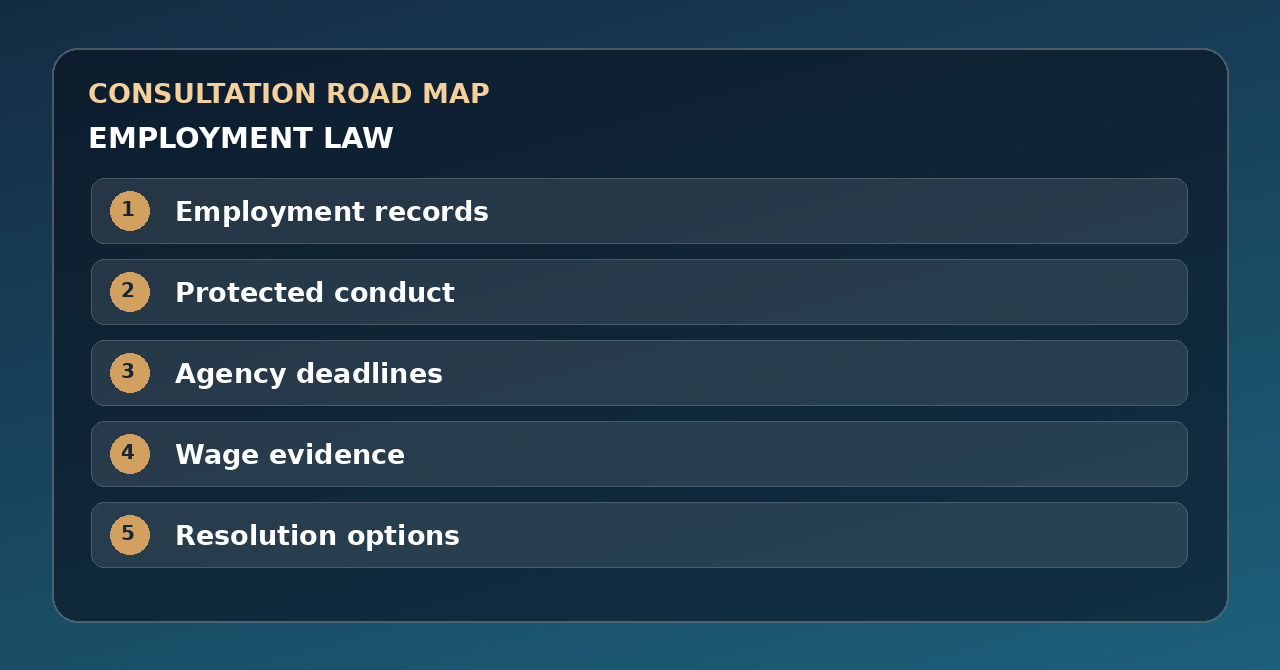
- Employment records. Create a brief, date-ordered note about employment records. Separate things personally observed from information relayed by someone else, and identify where an original record can be found.
- Protected conduct. For protected conduct, list documents already held, documents another party controls, and any information that might not remain available indefinitely. Record an authorized way to request or preserve it.
- Agency deadlines. Write down what a successful near-term decision about agency deadlines would actually look like. Do not assume that the best outcome is necessarily a courtroom judgment or a large payment.
- Wage evidence. Explain the practical constraints affecting wage evidence: available time, work obligations, cash flow, family responsibilities, privacy concerns, and any existing legal order or contractual duty.
- Resolution options. Ask who handles resolution options within the engagement, what it costs, how progress is communicated, and whether a change in circumstances requires a separate agreement or outside specialist.
Comparing counsel without relying on marketing promises
Interviewing two or more qualified lawyers can expose useful differences in experience, staffing, scope, and communication. Ask for a plain-language explanation of the proposed work concerning employment law, a copy of the written fee arrangement, and an estimate of foreseeable expenses that are not part of the basic charge. An advertisement describing an impressive past result is not a reliable forecast of how an unrelated matter will end.
Verify the attorney’s eligibility to practice in the appropriate jurisdiction, potential conflicts, and who would personally handle the file. For business & civil legal services, expertise is not interchangeable across every specialty: distinguish licensing, local procedure, negotiation, litigation, and any necessary technical or administrative knowledge. If the issue involves an imminent filing date or safety concern, emphasize prompt, jurisdiction-specific help rather than prolonged comparison shopping.
Frequently asked questions
Does unfair treatment automatically prove discrimination?
No. A legally protected basis or other covered unlawful conduct generally must be established. Your situation may require further review of local procedures and original documents.
Can I wait until an internal investigation ends?
Do not assume internal procedures extend an external agency filing deadline. Ask the professional which assumptions in that answer depend on the actual record.
Should I download the entire company drive?
No. Preserve only materials you may lawfully access and seek advice about sensitive records. A reliable next step is to confirm the governing rule before signing or filing anything.
Do managers always qualify for overtime exemptions?
Job title alone is insufficient; the applicable duties and compensation tests matter. Written scope and timelines can help prevent confusion about what assistance is included.
Can an attorney review a severance offer?
Yes. A targeted review may reveal obligations not obvious from the payout figure. If a deadline is approaching, seek individualized help rather than waiting for an online answer.
Bottom line for employment law
Start with the actual issue, a truthful chronology, and the documents that can substantiate it. Compare legal help based on relevant experience, a clear scope, transparent financial terms, and how the professional explains uncertainty. The strongest first step is often to preserve an option and improve the quality of the information available for the next decision—not to assume the most dramatic outcome is inevitable.