
Personal & Family Legal Services | U.S. Legal Explainer
A clear look at the separate legal, scientific, and driving-privilege questions arising from a DUI accusation.
Choosing legal representation for DUI defense is easier when the issue is divided into decisions instead of marketing claims. The attorney’s work depends on the facts, jurisdiction, available documents, the other people or organizations involved, and the outcome the person actually needs. This guide explains the moving parts without claiming that one legal strategy fits every case in the United States.
The topics below move from the first signs of a legal problem to evidence, procedural choices, and the practical questions to ask before signing an engagement. They are written for readers who want to understand a professional service, not for people seeking a substitute for advice based on a confidential review of their particular circumstances. State law, venue, contract wording, and filing dates can all alter the analysis.
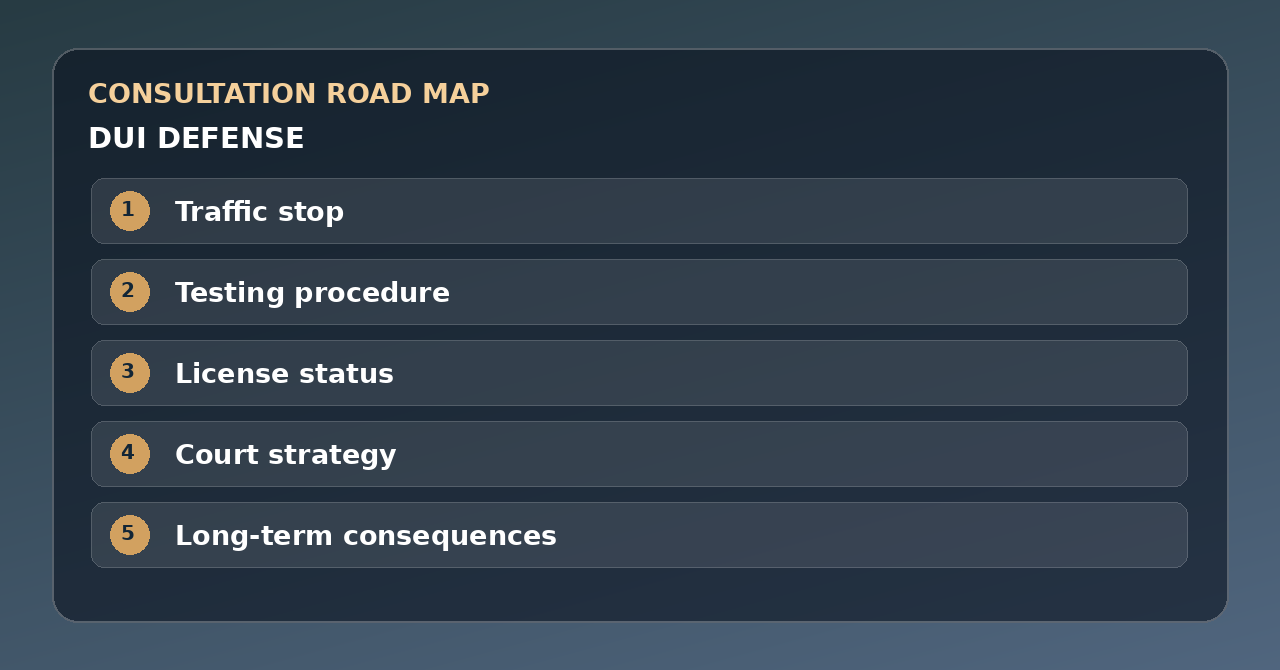
For personal & family legal services, an effective first conversation often produces a narrower, more useful question than “Can I win?” It should clarify which facts are established, which claims or obligations are still disputed, what records matter, what action cannot wait, and who is responsible for the next step. Use the five-part decision map as a navigation aid rather than a scorecard predicting results.
A DUI can create two tracks
A driving-under-the-influence allegation may lead to a criminal case and a separate administrative license process. Deadlines, available hearings, suspension rules, and appeal procedures differ by jurisdiction. Waiting for the first criminal appearance before checking the licensing notice can leave an important issue unaddressed.
Ask the prospective lawyer to demonstrate how a dui can create two tracks fits into the specific DUI defense decision, what they would examine first, and what finding would prompt a change of course. Their answer should acknowledge that a short initial meeting cannot substitute for reviewing the actual evidence.
How the stop began
Counsel examines the documented reason for the stop, observations, timeline, camera footage, roadside interactions, and the legal standards applicable to an arrest. The validity of a stop is not decided by a broad statement that police need suspicion for everything; exact procedures and exceptions matter.
For this stage, keep the testing procedure question distinct from the broader dispute. Ask whether the service being offered covers investigation, document preparation, negotiation, and appearances, or only selected tasks. A written scope prevents misunderstandings when the work expands.
Testing is technical evidence
Breath instruments, blood draws, collection times, maintenance, calibration records, chain of custody, and laboratory procedures may affect how test results are interpreted. A lawyer may consult a qualified forensic specialist to explore particular limitations. Neither a number on a report nor a generic claim of equipment error resolves every question.
Before acting on advice about testing is technical evidence, ask what is a binding requirement and what is merely a recommended practice. Counsel should distinguish the two, note whose authorization is needed, and flag any step that might permanently narrow the available options.
Field observations and context
Officer notes may describe driving, speech, coordination, balance, instructions, or roadside exercises. Lighting, weather, medical conditions, footwear, language comprehension, and camera angles can provide context. The defense should test records carefully without inventing a medical explanation or altering source footage.
In a case involving DUI defense, the timing of this decision can be as important as its substance. Request the next material deadline, the form of notice or filing that applies, and a sensible contingency if a record or third-party response arrives later than expected.
Administrative license consequences
The notice may provide a narrow period for requesting a hearing or temporary permit where available. Commercial drivers and people with professional driving duties may face additional regulations. Ask about the exact status of the privilege to drive while proceedings continue; assumptions based on a pending appeal can be costly.
Compare two plausible approaches to administrative license consequences: a narrowly scoped early action and a more resource-intensive review. Have the lawyer explain what additional information the larger effort could provide and why that information is worth its cost in these circumstances.
The meaning of prior allegations
Prior convictions, out-of-state records, age, alleged injury, and other factors may affect classification or exposure in particular jurisdictions. Counsel should obtain reliable records rather than rely on memory. Discussions about diversion, treatment requirements, and negotiated outcomes must reflect actual local eligibility rules.
Before agreeing to the proposed traffic stop task, identify who will prepare it, what the client must supply, and what counts as a satisfactory result. A well-defined deliverable is especially useful when several professionals work on different pieces of the matter.
Financial effects beyond a fine
A case may involve legal costs, assessments, insurance changes, transportation, employment restrictions, treatment, or monitoring. Consider these practical effects while evaluating a disposition. An attorney should explain direct and collateral implications rather than discuss only whether jail is likely.
The sensible question is not whether financial effects beyond a fine sounds important in the abstract. It is whether a particular legal or factual uncertainty justifies immediate attention, and what consequence follows if that uncertainty is left unresolved during the next phase.
Planning the defense calendar
Collect the citation, release paperwork, test notices, administrative letters, and every hearing date. Preserve receipts or location records that may bear on the timeline. Confirm whether counsel handles both the criminal and licensing components or whether separate representation is necessary.
If planning the defense calendar becomes contested, ask how the attorney would explain the issue to a decision-maker who has never met the parties. Organizing the supporting facts in that order can reveal missing documents and identify assertions that still need independent verification.
Evaluating counsel
Ask about local procedure, experience assessing forensic evidence, expected phases of work, fee coverage for hearings and experts, and availability for time-sensitive contact. Claims of a guaranteed dismissal or a universal testing loophole are unreliable. Seek a candid explanation of the strongest and weakest facts.
An intake conversation about evaluating counsel should end with a decision owner, a realistic timeframe, and a method for reporting changes. This turns a broad professional promise into a practical working arrangement the client can understand and monitor.
A realistic example: how the pieces connect
Illustrative scenario—not an account of an actual client or legal outcome. A rideshare driver is charged after a late-night stop and later receives a motor-vehicle agency letter. Counsel treats the court case and license notice separately, obtains available video and test documents, and determines whether a hearing request must be made quickly. The driver’s work dependence on a license makes the administrative review especially important, but it does not predetermine the legal outcome.
The useful lesson for a reader researching DUI defense is to identify exactly where professional judgment is required. One professional may need to interpret documents, another may supply technical facts, and a court, agency, or contracting party may ultimately control the result. A good attorney can specify which questions are answerable today and which remain conditional without overstating certainty.
Preparing for the first attorney consultation
Use the following working file to make an initial conversation more productive. It is not a substitute for any court form, government instruction, or document request your adviser actually provides.
- Traffic stop. Create a brief, date-ordered note about traffic stop. Separate things personally observed from information relayed by someone else, and identify where an original record can be found.
- Testing procedure. For testing procedure, list documents already held, documents another party controls, and any information that might not remain available indefinitely. Record an authorized way to request or preserve it.
- License status. Write down what a successful near-term decision about license status would actually look like. Do not assume that the best outcome is necessarily a courtroom judgment or a large payment.
- Court strategy. Explain the practical constraints affecting court strategy: available time, work obligations, cash flow, family responsibilities, privacy concerns, and any existing legal order or contractual duty.
- Long-term consequences. Ask who handles long-term consequences within the engagement, what it costs, how progress is communicated, and whether a change in circumstances requires a separate agreement or outside specialist.
Comparing counsel without relying on marketing promises
Interviewing two or more qualified lawyers can expose useful differences in experience, staffing, scope, and communication. Ask for a plain-language explanation of the proposed work concerning DUI defense, a copy of the written fee arrangement, and an estimate of foreseeable expenses that are not part of the basic charge. An advertisement describing an impressive past result is not a reliable forecast of how an unrelated matter will end.
Verify the attorney’s eligibility to practice in the appropriate jurisdiction, potential conflicts, and who would personally handle the file. For personal & family legal services, expertise is not interchangeable across every specialty: distinguish licensing, local procedure, negotiation, litigation, and any necessary technical or administrative knowledge. If the issue involves an imminent filing date or safety concern, emphasize prompt, jurisdiction-specific help rather than prolonged comparison shopping.
Frequently asked questions
Can a license be affected before conviction?
Administrative procedures may operate separately, depending on state law. Your situation may require further review of local procedures and original documents.
Is a breath reading always conclusive?
Testing must be evaluated under applicable evidentiary rules and the actual record. Ask the professional which assumptions in that answer depend on the actual record.
Should I ignore agency mail?
No. It may contain deadlines distinct from court dates. A reliable next step is to confirm the governing rule before signing or filing anything.
Does a lawyer handle both proceedings automatically?
Ask whether the engagement expressly includes each track. Written scope and timelines can help prevent confusion about what assistance is included.
Will every first offense qualify for diversion?
No. Eligibility and availability are jurisdiction-specific. If a deadline is approaching, seek individualized help rather than waiting for an online answer.
Bottom line for DUI defense
Start with the actual issue, a truthful chronology, and the documents that can substantiate it. Compare legal help based on relevant experience, a clear scope, transparent financial terms, and how the professional explains uncertainty. The strongest first step is often to preserve an option and improve the quality of the information available for the next decision—not to assume the most dramatic outcome is inevitable.