
Business & Civil Legal Services | U.S. Legal Explainer
Learn how coverage lawyers review denials, documentation, exclusions, appeals, and the difference between a disputed claim and bad faith.
Choosing legal representation for insurance coverage disputes is easier when the issue is divided into decisions instead of marketing claims. The attorney’s work depends on the facts, jurisdiction, available documents, the other people or organizations involved, and the outcome the person actually needs. This guide explains the moving parts without claiming that one legal strategy fits every case in the United States.
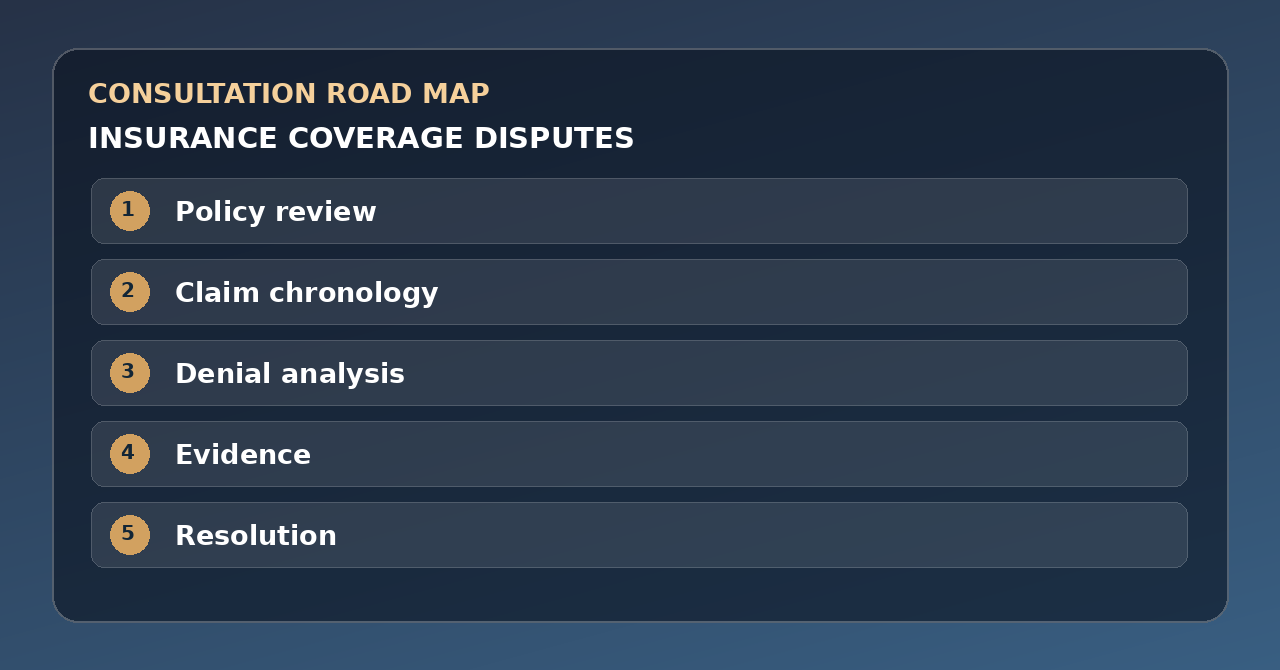
The topics below move from the first signs of a legal problem to evidence, procedural choices, and the practical questions to ask before signing an engagement. They are written for readers who want to understand a professional service, not for people seeking a substitute for advice based on a confidential review of their particular circumstances. State law, venue, contract wording, and filing dates can all alter the analysis.
For business & civil legal services, an effective first conversation often produces a narrower, more useful question than “Can I win?” It should clarify which facts are established, which claims or obligations are still disputed, what records matter, what action cannot wait, and who is responsible for the next step. Use the five-part decision map as a navigation aid rather than a scorecard predicting results.
Coverage begins with a contract
An insurance dispute requires reading the actual policy, endorsements, declarations, exclusions, limits, deductibles, conditions, and relevant notices. Marketing summaries may omit decisive details. A lawyer identifies the particular insured interest, event, claim period, and provision the insurer invokes rather than treating every refusal as unlawful.
Ask the prospective lawyer to demonstrate how coverage begins with a contract fits into the specific insurance coverage disputes decision, what they would examine first, and what finding would prompt a change of course. Their answer should acknowledge that a short initial meeting cannot substitute for reviewing the actual evidence.
Understand the denial letter
A written explanation may cite late notice, insufficient proof, excluded damage, alleged misrepresentation, valuation, or a policy interpretation. Each reason raises a different evidentiary response. Track deadlines for reconsideration, appraisal, suit limitation, and any administrative process without assuming they are identical.
For this stage, keep the claim chronology question distinct from the broader dispute. Ask whether the service being offered covers investigation, document preparation, negotiation, and appearances, or only selected tasks. A written scope prevents misunderstandings when the work expands.
Preserve loss documentation
Photos, repair estimates, invoices, inventory, expert reports, contemporaneous messages, weather records, and mitigation expenses can matter. Maintain originals and document what changed after the loss. An insured person may have obligations to prevent additional damage while preserving evidence of what occurred.
Before acting on advice about preserve loss documentation, ask what is a binding requirement and what is merely a recommended practice. Counsel should distinguish the two, note whose authorization is needed, and flag any step that might permanently narrow the available options.
Valuation is a distinct argument
An insurer may accept that an event is covered while disputing replacement cost, actual cash value, depreciation, scope of repair, or additional living expense. Counsel may coordinate with a licensed appraiser or specialist when needed. A disagreement about the number is not always a denial of coverage.
In a case involving insurance coverage disputes, the timing of this decision can be as important as its substance. Request the next material deadline, the form of notice or filing that applies, and a sensible contingency if a record or third-party response arrives later than expected.
Bad faith has legal elements
States regulate claim handling differently, and the standard for extra-contractual insurer liability varies. A slow or disappointing response alone does not prove bad faith. An attorney compares documented conduct with applicable duties, reasonableness, communications, and the policy record before describing potential remedies.
Compare two plausible approaches to bad faith has legal elements: a narrowly scoped early action and a more resource-intensive review. Have the lawyer explain what additional information the larger effort could provide and why that information is worth its cost in these circumstances.
Property, health, and liability claims differ
Homeowner damage, disability benefits, commercial interruption, auto coverage, and liability-defense obligations involve distinct contract language and regulatory frameworks. A lawyer should have experience with the precise product and jurisdiction. Do not assume a procedure available in one category applies across the insurance market.
Before agreeing to the proposed policy review task, identify who will prepare it, what the client must supply, and what counts as a satisfactory result. A well-defined deliverable is especially useful when several professionals work on different pieces of the matter.
Appraisal, mediation, and suit
A policy may contain appraisal or alternative dispute procedures, yet the scope of those processes can be limited. Counsel assesses what they can decide, how neutral participants are selected, and whether using them affects another deadline. Litigation may clarify contract interpretation or seek payment when negotiation has stalled.
The sensible question is not whether appraisal, mediation, and suit sounds important in the abstract. It is whether a particular legal or factual uncertainty justifies immediate attention, and what consequence follows if that uncertainty is left unresolved during the next phase.
Fees and economic sense
Request a cost-benefit analysis covering the disputed amount, experts, filing expenses, fee-shifting possibility, and expected timing. Some engagements are hourly while others involve contingent or hybrid structures where allowed. The realistic net benefit matters more than the emotional appeal of suing an insurer.
If fees and economic sense becomes contested, ask how the attorney would explain the issue to a decision-maker who has never met the parties. Organizing the supporting facts in that order can reveal missing documents and identify assertions that still need independent verification.
How to prepare a concise consultation
Bring the complete policy, claim number, initial notice, adjuster correspondence, denial, estimates, and a dated loss timeline. Identify which sums have been paid and which remain disputed. An attorney can then distinguish coverage, valuation, and procedural issues rather than spending the first meeting reconstructing missing basics.
An intake conversation about how to prepare a concise consultation should end with a decision owner, a realistic timeframe, and a method for reporting changes. This turns a broad professional promise into a practical working arrangement the client can understand and monitor.
A realistic example: how the pieces connect
Illustrative scenario—not an account of an actual client or legal outcome. A restaurant submits a water-damage claim after a supply line fails. The insurer accepts part of the repair bill but excludes some equipment and questions lost income. Counsel separates the equipment-coverage issue from valuation and business-interruption requirements, then reviews policy endorsements and accounting records. Calling the entire matter bad faith before checking those terms would be premature.
The useful lesson for a reader researching insurance coverage disputes is to identify exactly where professional judgment is required. One professional may need to interpret documents, another may supply technical facts, and a court, agency, or contracting party may ultimately control the result. A good attorney can specify which questions are answerable today and which remain conditional without overstating certainty.
Preparing for the first attorney consultation
Use the following working file to make an initial conversation more productive. It is not a substitute for any court form, government instruction, or document request your adviser actually provides.
- Policy review. Create a brief, date-ordered note about policy review. Separate things personally observed from information relayed by someone else, and identify where an original record can be found.
- Claim chronology. For claim chronology, list documents already held, documents another party controls, and any information that might not remain available indefinitely. Record an authorized way to request or preserve it.
- Denial analysis. Write down what a successful near-term decision about denial analysis would actually look like. Do not assume that the best outcome is necessarily a courtroom judgment or a large payment.
- Evidence. Explain the practical constraints affecting evidence: available time, work obligations, cash flow, family responsibilities, privacy concerns, and any existing legal order or contractual duty.
- Resolution. Ask who handles resolution within the engagement, what it costs, how progress is communicated, and whether a change in circumstances requires a separate agreement or outside specialist.
Comparing counsel without relying on marketing promises
Interviewing two or more qualified lawyers can expose useful differences in experience, staffing, scope, and communication. Ask for a plain-language explanation of the proposed work concerning insurance coverage disputes, a copy of the written fee arrangement, and an estimate of foreseeable expenses that are not part of the basic charge. An advertisement describing an impressive past result is not a reliable forecast of how an unrelated matter will end.
Verify the attorney’s eligibility to practice in the appropriate jurisdiction, potential conflicts, and who would personally handle the file. For business & civil legal services, expertise is not interchangeable across every specialty: distinguish licensing, local procedure, negotiation, litigation, and any necessary technical or administrative knowledge. If the issue involves an imminent filing date or safety concern, emphasize prompt, jurisdiction-specific help rather than prolonged comparison shopping.
Frequently asked questions
Does every denial prove bad faith?
No. Extra-contractual claims have specific standards that vary by state. Your situation may require further review of local procedures and original documents.
Can I rely on the policy summary?
Use the full contract and endorsements for serious coverage questions. Ask the professional which assumptions in that answer depend on the actual record.
What if only the amount is disputed?
Appraisal or a supported negotiation may be relevant depending on policy terms. A reliable next step is to confirm the governing rule before signing or filing anything.
Should I throw damaged property away?
Ask about documentation and preservation before disposal when practical and safe. Written scope and timelines can help prevent confusion about what assistance is included.
Can a claim have more than one deadline?
Yes. Policy and statutory time periods may differ. If a deadline is approaching, seek individualized help rather than waiting for an online answer.
Bottom line for insurance coverage disputes
Start with the actual issue, a truthful chronology, and the documents that can substantiate it. Compare legal help based on relevant experience, a clear scope, transparent financial terms, and how the professional explains uncertainty. The strongest first step is often to preserve an option and improve the quality of the information available for the next decision—not to assume the most dramatic outcome is inevitable.