







Author: Domingo H.C
Published on: December 9, 2025
Introduction
The forms of state define how a country is politically and territorially organized. They determine how power is distributed, whether regions have autonomy, and how national and local governments interact. Understanding this concept is essential for students, professionals, entrepreneurs, and anyone interested in law, politics, and public administration.
Throughout history, different countries have adopted different forms of state based on their culture, geography, and political development. In this article, you will learn the main forms of state, their key characteristics, advantages, disadvantages, and real-world examples.
What Is a Form of State?
A form of state refers to the way political power is structured and distributed across a country’s territory. It defines:
-
How centralized or decentralized the government is
-
Whether regions have political autonomy
-
How laws are applied
-
The relationship between national and local authorities
It is important not to confuse the form of state with the form of government. The form of state explains how the country is organized territorially, while the form of government explains who governs (democracy, monarchy, dictatorship, etc.).
1. Unitary State
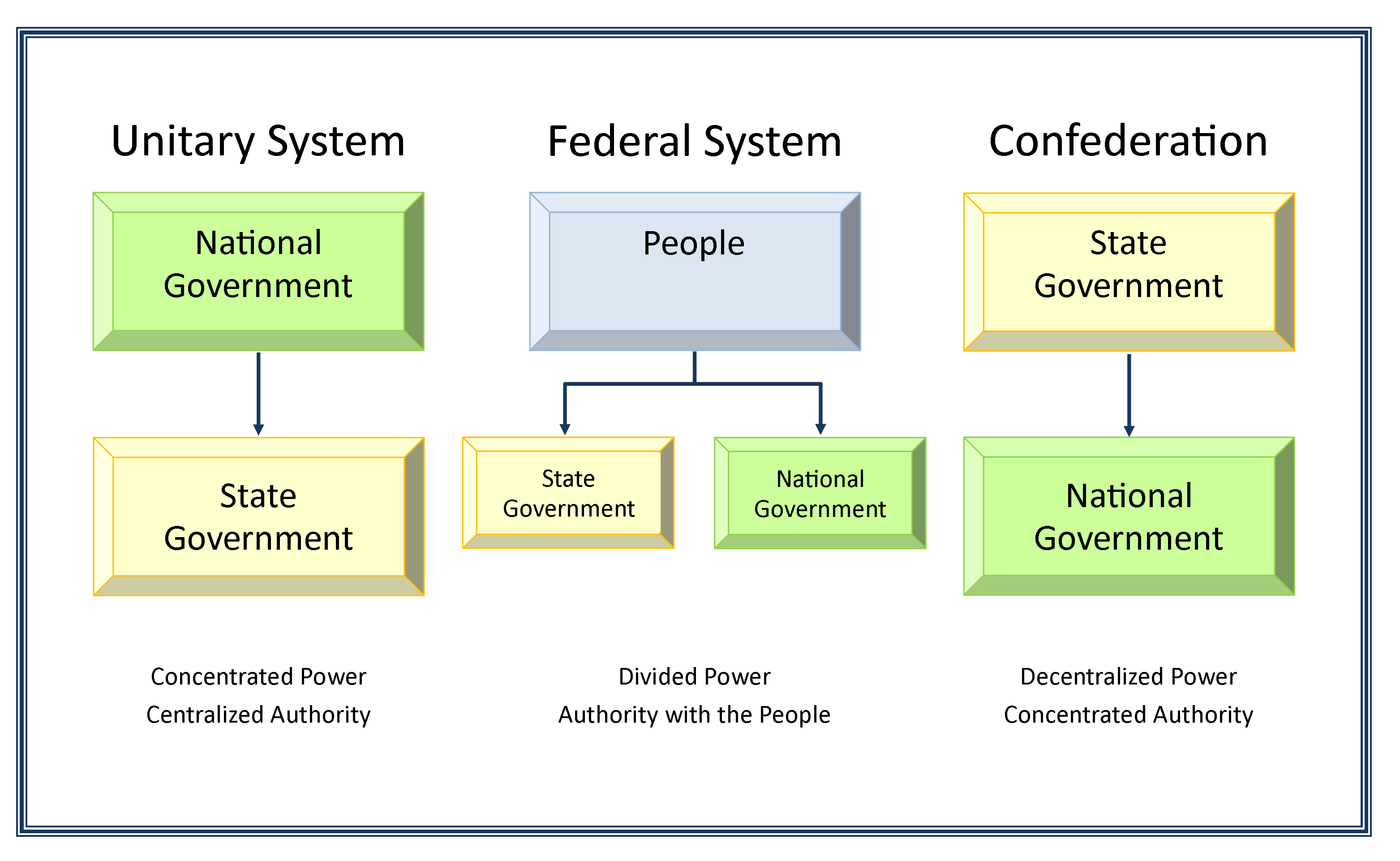

A unitary state is one in which all political power is concentrated in a single central government. Regional or local governments depend entirely on national authority and do not have independent political power.
Main Characteristics:
-
One central government
-
One national constitution
-
Uniform laws across the entire country
-
No political autonomy for regions
Examples of Unitary States:
-
Dominican Republic
-
Chile
-
Colombia
-
Peru
-
France
Advantages:
-
Strong political unity
-
Faster decision-making
-
Equal application of laws
Disadvantages:
-
Limited regional development
-
Excessive centralization
-
Fewer local decision-making powers
2. Federal State

A federal state is made up of several states or regions that have their own governments and legal powers but remain united under a national government. Each region has political autonomy within the limits established by the constitution.
Main Characteristics:
-
Division of power between national and regional governments
-
Independent constitutions for each state
-
Political autonomy
-
One unified country
Examples of Federal States:
-
United States
-
Mexico
-
Brazil
-
Argentina
-
Germany
Advantages:
-
Strong regional development
-
Political participation at local levels
-
Balanced distribution of power
Disadvantages:
-
Conflicts between state and federal governments
-
Higher administrative costs
-
Legal differences between regions
3. Confederate State


A confederate state is a voluntary association of independent states that unite for specific purposes such as defense, trade, or foreign relations. Each member state maintains full sovereignty.
This form of state is extremely rare today.
Main Characteristics:
-
Independent states
-
Weak central authority
-
Voluntary union
-
Right of separation
Historical Example:
-
The Confederate States of America (19th century)
Some political experts consider the European Union to have partial confederal characteristics, although it is not a true confederation.
4. Regional or Autonomous State


A regional (or autonomous) state is a system that combines elements of unitary and federal states. The central government remains strong, but regions have limited political autonomy.
Main Characteristics:
-
One central government
-
Regions with limited self-government
-
Political and administrative autonomy
-
Strong national authority
Examples of Regional States:
-
Spain
-
Italy
Difference Between Form of State and Form of Government
| Form of State | Form of Government |
|---|---|
| Unitary, Federal, Confederate, Regional | Democracy, Monarchy, Dictatorship |
| Territorial organization | Who governs |
| Structure of power | Type of political system |
A country can combine both:
-
Federal State + Democratic Republic (United States)
-
Unitary State + Democracy (Chile)
-
Regional State + Constitutional Monarchy (Spain)
Why Forms of State Matter
The form of state directly affects:
-
Economic development
-
Political stability
-
Regional equality
-
Public administration efficiency
-
Distribution of public resources
-
Citizen participation
An ineffective form of state can create poverty, political conflict, corruption, and inequality.
Real-World Examples
-
United States: Federal State
-
Spain: Regional (Autonomous) State
-
Dominican Republic: Unitary State
-
Brazil: Federal State
-
Chile: Unitary State
Conclusion
The forms of state define how political power is organized within a nation. No single model is perfect for all countries. Each form of state reflects historical development, cultural values, geographic conditions, and political priorities.
Understanding these systems allows citizens to better understand how their governments function and how decisions are made at both national and local levels.
Final Call to Action
👉 If you want to continue learning about government systems, law, politics, and international structures, explore more educational articles on Haroon E-Store and stay informed with reliable, well-researched content.